3D Woven
Denim
Five-pocket jeans woven to shape on an industrial Jacquard loom. Panels, seams and graphics come off the loom together, so almost nothing is cut away and 40% of the seams never need sewing.
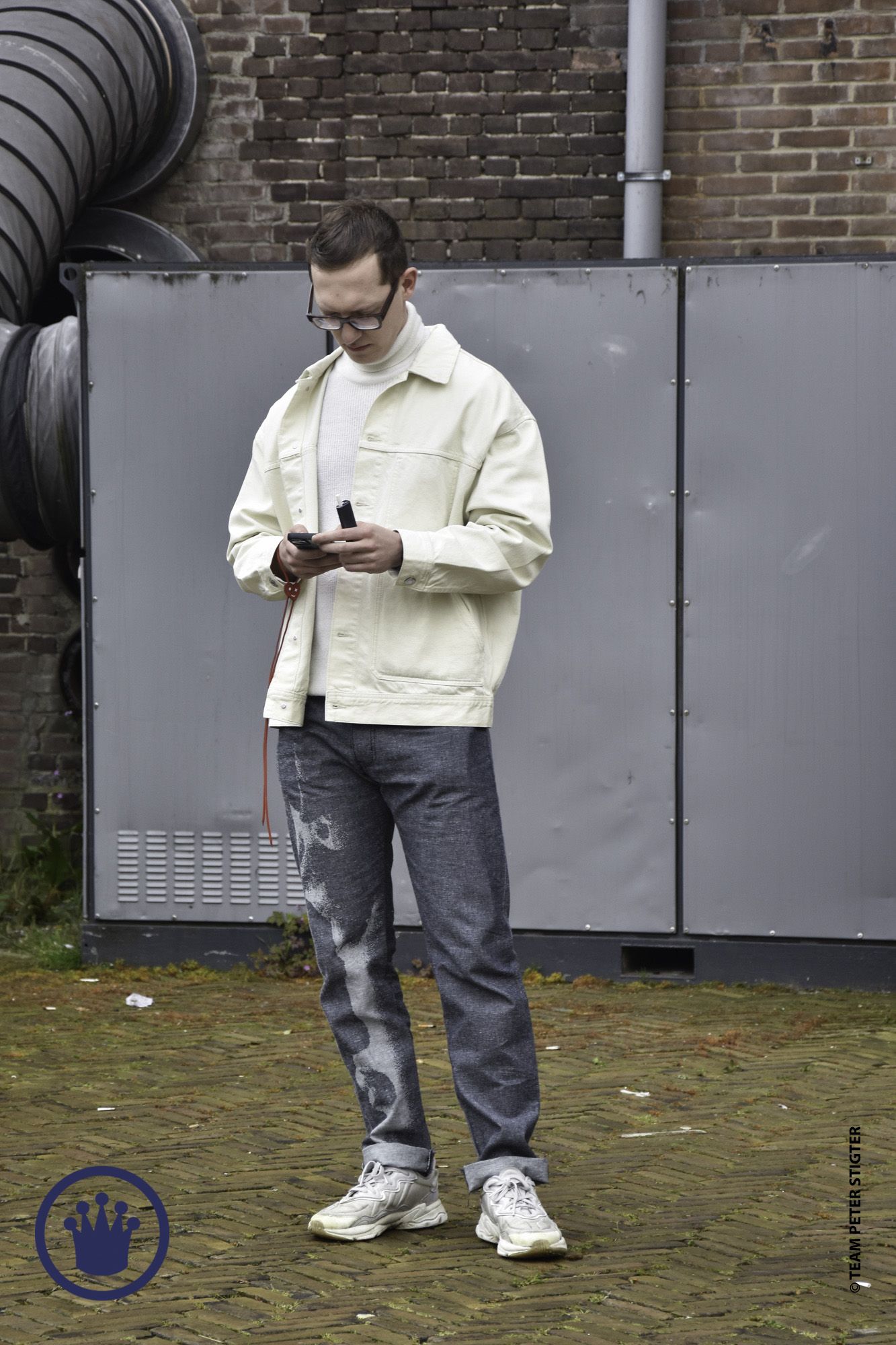
WornThe jeans at Kingpins Amsterdam, April 2024. The sculpture graphic on the leg is woven, not printed. Photo: Team Peter Stigter.
A Jacquard loom can weave the pattern into the cloth.
Jeans start as flat denim that is cut into panels and sewn back together. Around a fifth of the fabric never makes it into the jeans, and every seam is another step on the sewing line.
A Jacquard loom can lift each warp thread on its own. Weave two layers at once, join them only where the pattern says, and the loom draws panel outlines, seams and pockets into the cloth. What remains is a guided cut and a short assembly.
It started with one line in a lecture: up to 80% of a product’s environmental impact is decided at the design stage. 3D weaving was still mostly academic research, so I set myself a commercial brief: a five-pocket that looks and feels like denim, made in an existing supply chain, with less cutting, sewing and waste.
“I bet it’s possible to create zero waste 3D woven jeans.”
At the start of the project
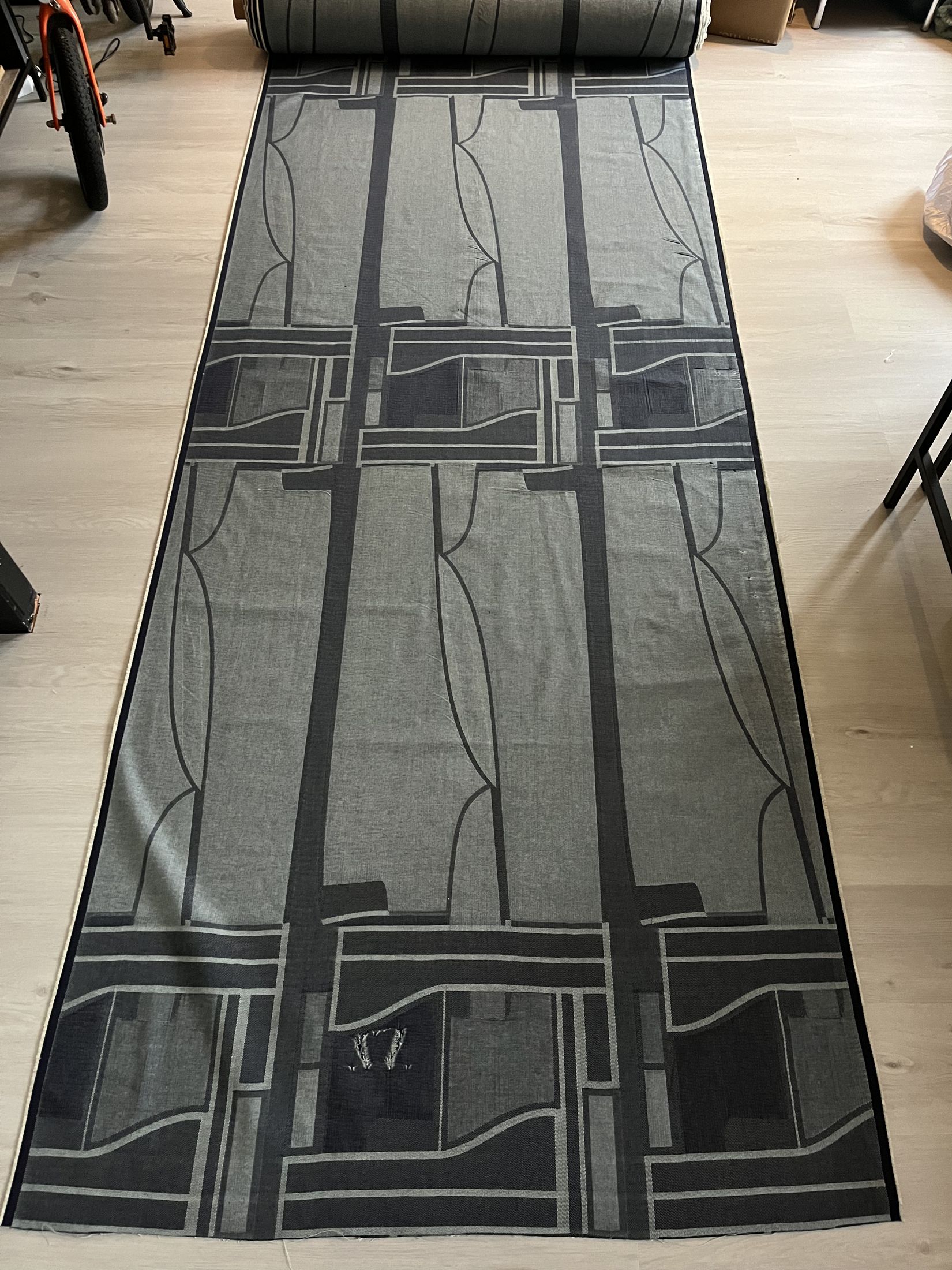
Woven to shape, the jeans need 40% less sewing.
Same five-pocket, same indigo warp, same kind of factory. The difference is where the pattern lives: on a cutting table, or in the loom.
Cut and sew
- 01Weave flat denim
- 02Lay out a marker, cut the panels
- 03Sew every seam
- 04Wash and finish
3D woven
- 01Weave every panel in one roll, layers and seams in place
- 02Finish the roll: soft inside, raw outside
- 03Cut along the woven lines
- 04Sew only what the loom cannot
Estimates from the thesis evaluation of the 3D woven pair against conventional cut and sew. Context: one pair of Levi’s 501 uses 3,781 litres of water and 33.4 kg CO₂e over its life (Levi Strauss & Co., 2015).
Losing the factory week meant testing twelve variations per run.
Select a stage, or use the arrows
Five versions to balance fit, waste and looks.
“Fixing the fly, only to move the pocket, and then the yoke is off.”
From my thesis, on balancing fit, waste and looks
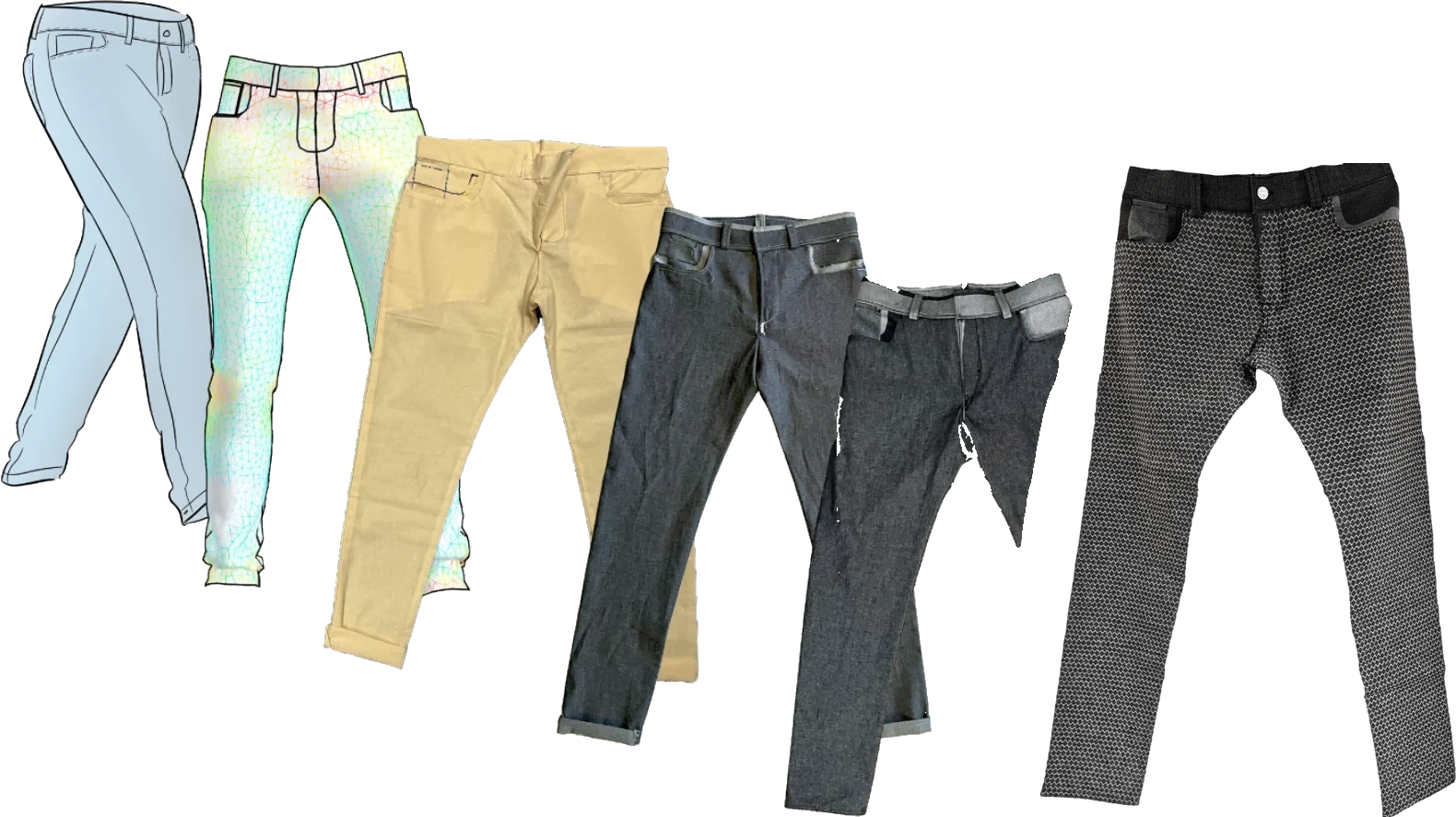
- V1Sketch to 3D
Folding structures and seam positions tested; two zero-waste concepts built in CLO3D.
- V2Cut and sew
Yoke curve added. The back pockets now come from the crotch cut-out, so that piece isn’t waste. Pattern split into a top and a bottom section.
- V3First woven
The first pair off the loom. Yoke raised and pockets enlarged for fit, a two-layer fly woven onto the waistband, seam allowances woven in.
- V4Second woven
Pockets turned inside out to hide fraying, a finer Ne 10 weft so the top section closes supple, shrinkage built into CLO3D, and room in the waistband for tailoring.
- V5Final
The top section flipped to show indigo instead of white weft, the yoke angle tuned to lose excess fabric at the back, and pattern and graphic editions from the same file.
Diamond Denim assembled pairs from my tech pack.
It covers the front, fly, pocket, back and pocket bag, with stitch types, placements and bar tacks in place of rivets. Their team in Pakistan worked from it and my assembly guide, without me on site.
Woven, cut, worn.
Swipe, drag or use the arrows. Or just keep scrolling.
The finished pair.
Photographed as woven. Select a detail, or step through with the arrows.
Front
Back
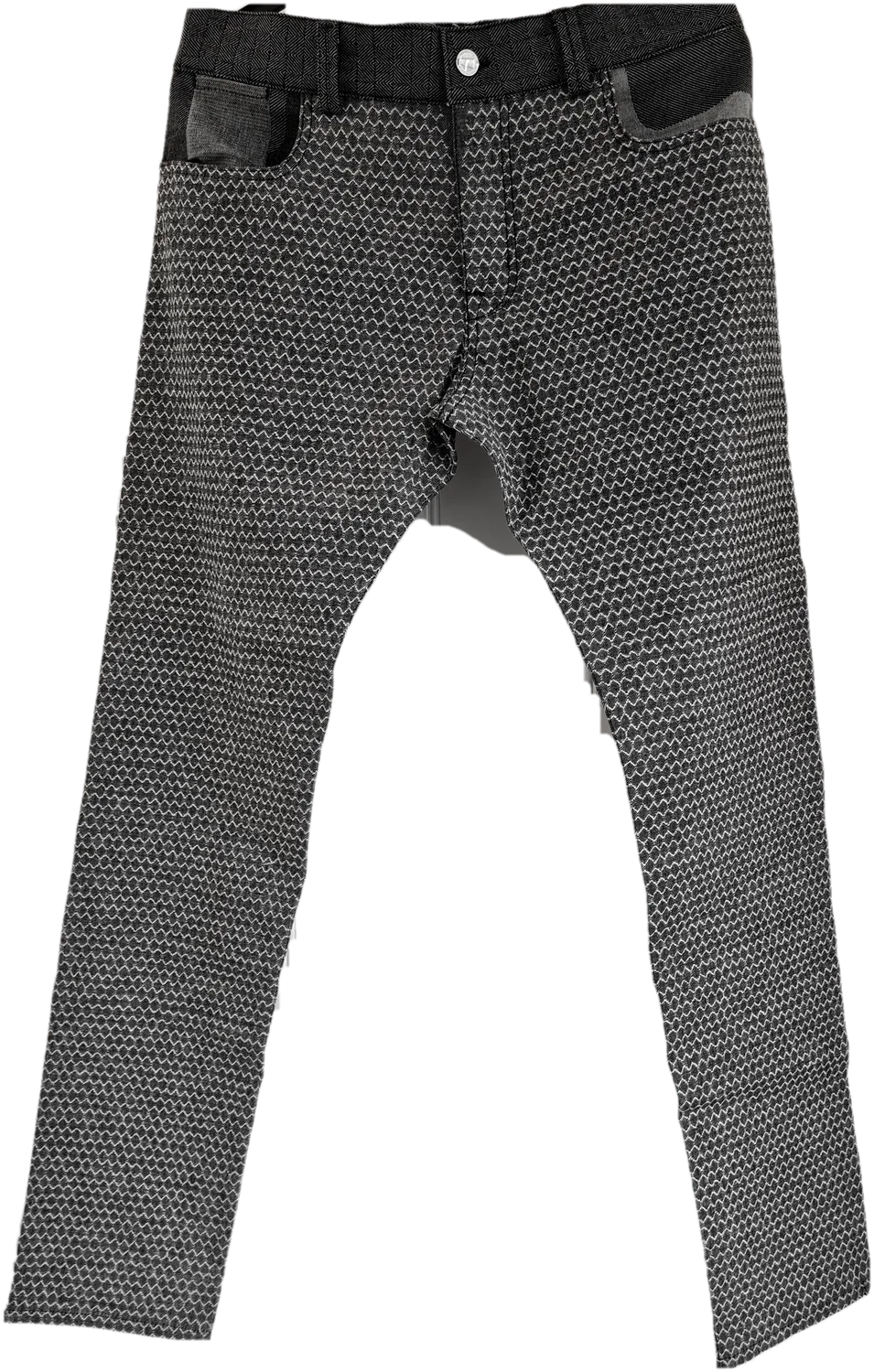
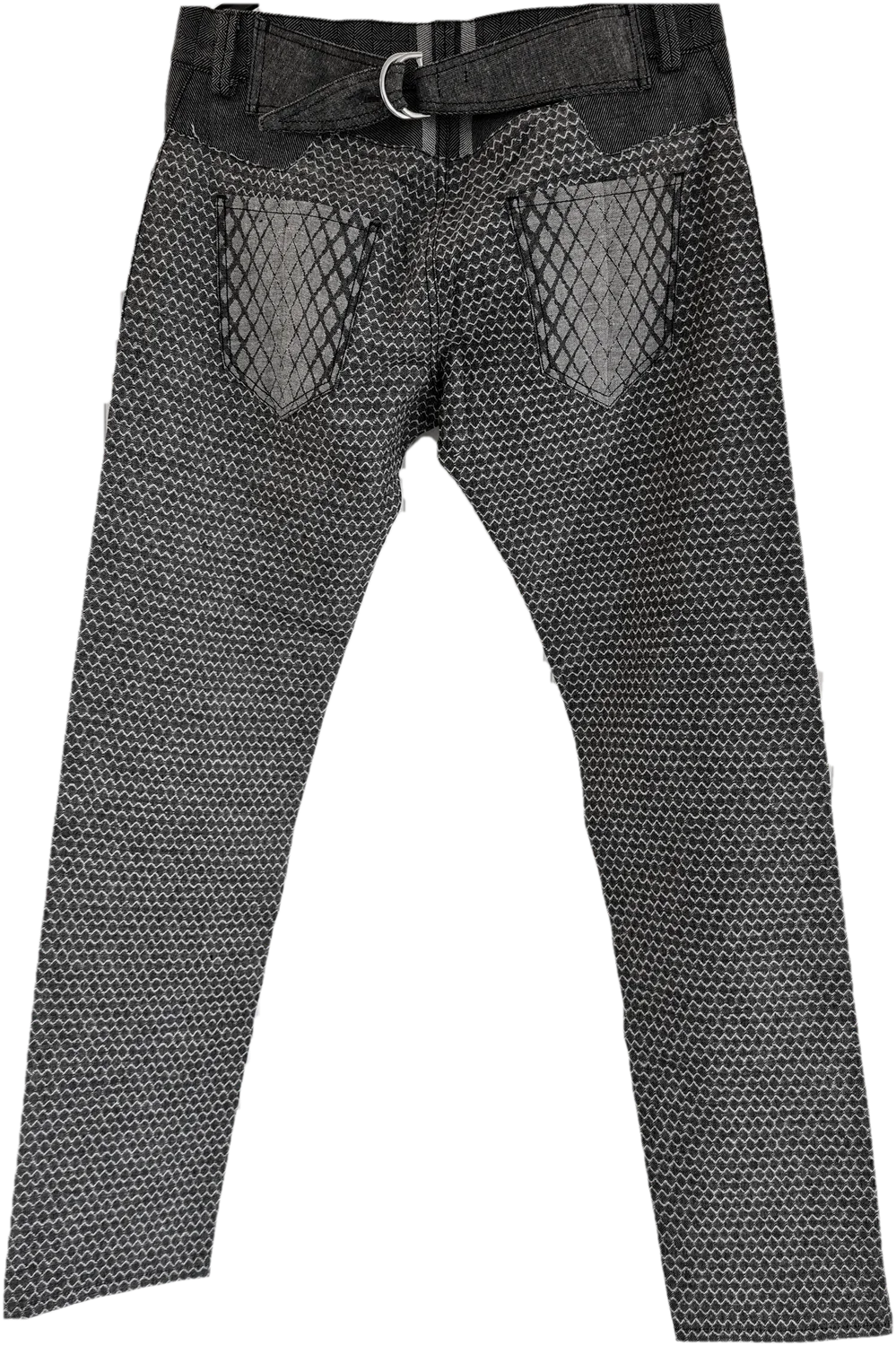
Pocket, label and graphic are part of the weave.
So nothing has to be peeled off or separated before the jeans are recycled.
Fifth pocket, woven in place
The base pair stays classic on purpose.
“Design really needs to be more conventional.”
Industry respondent
“I want to see a garment pattern that is uniquely a product of 3D weaving.”
Industry respondent
Respondents were split, and both camps have a point. The base pair stays classic so the industry recognises it as denim, and three weave variables make editions that only 3D weaving can produce.
Every surface effect is woven in.
The effects come from how the threads bind, so there is no print or trim to remove later.
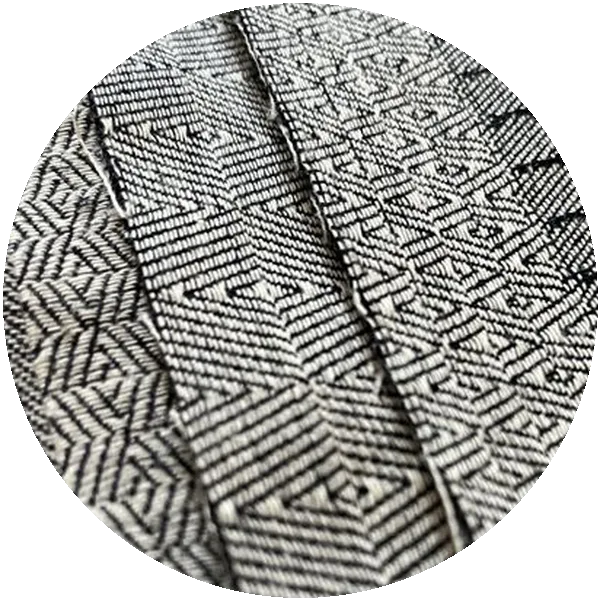
The same pattern, turned. Left and right twill run the pattern in different directions.
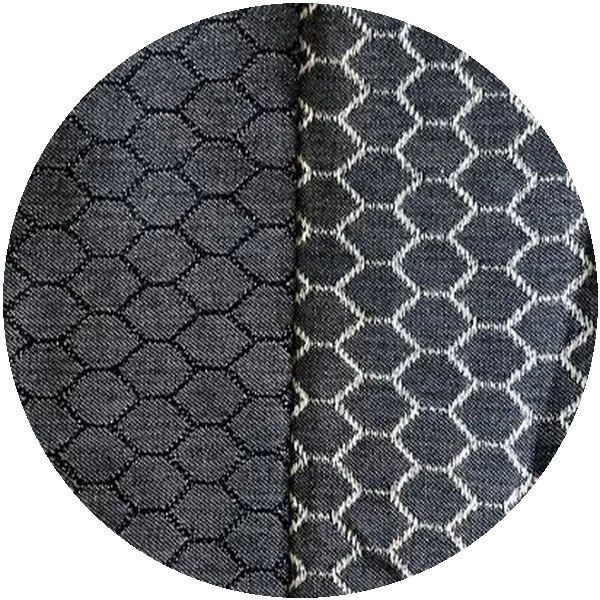
Different weave structures sit side by side in one fabric.
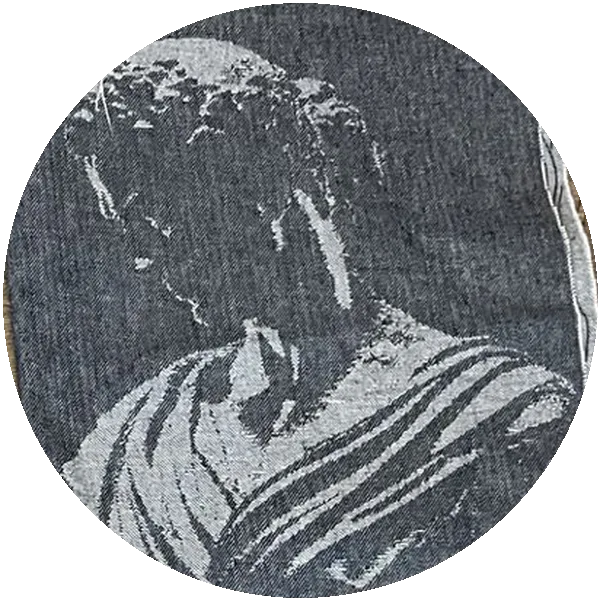
Warp and weft swap places to draw an image in contrast.
01 / 03 · OrientationThe same pattern, turned. Left and right twill run the pattern in different directions.
02 / 03 · StructureDifferent weave structures sit side by side in one fabric.
03 / 03 · GraphicWarp and weft swap places to draw an image in contrast.
CombinedMix and match all three. Only the file changes, so a new edition costs almost nothing extra to make.
The industry saw it at three trade shows.
16 of the 50+ denim professionals at the tech talk answered an anonymous survey. 10 of them had more than 10 years in the industry, and half named zero waste as the most interesting part.
See value for a more sustainable industry
Expect brands to adopt it within 5 years
Would accept up to 25% higher production cost
“Great to see the industry challenged.”
Industry respondent
Seven respondents doubted the look and feel and six the scale and cost. They have a point: until there is a size range, a cost model and a measured assembly time, this stays a proof of concept.
PressSourcing Journal: New Project Explores Creative and Sustainable Benefits of 3D Woven Jeans
April 2024Kingpins Loves Education panel and light installation, two weeks after I graduated.
The jeans in the Kingpins light installation
Event photos: Kingpins Amsterdam and Team Peter Stigter, April 2024
Eindhoven, October 2024Part of the Secrid Talent Podium, in the section by Milou Voorwinden. The jeans shown with woven panels and yarn.
Secrid Talent Podium, Dutch Design Week 2024
Munich, 2025A similar setup, this time with the graphic edition of the jeans.
The graphic edition at Munich Fabric Start
This took 3D weaving from academic research to jeans an existing supply chain can make.
The final pair meets the brief: it looks and feels like denim, Diamond Denim made it on standard industrial Jacquard looms, and it needs 40% less sewing with almost no cutting waste. At technology readiness level 6 to 7 it is past the lab but not yet on the shelf. To get it there I would measure assembly time first, then build a full size range and a cost model, and later patterns that fit from a body scan.
“Every obstacle provided an opportunity for improvement, both in my skills and the 3D woven design.”
From my thesis, reflecting on the results
ChairDr. Holly McQuillan, TU Delft
Mentor and weave expertMilou Voorwinden, TU Delft
Industry partnerDiamond Denim: Maurizio Baldi, Farhan Afzal
Denim expertMohsin Sajid, Endrime
Builds onBarbara Vroom’s 3D woven denim jacket and Sterre de Jager’s systems study
Tech talkWatch on YouTube
Next: zero-waste streetwear.
Zero-waste pattern concepts in CLO3D: a tracksuit, a baggy set with an oversized graphic, and a dress.
Each could follow the route of the jeans: one map of bindings, woven to shape, then a short assembly. They show the method isn’t limited to five-pocket jeans.
Zero-waste tracksuit, CLO3D
The moment before something is madeAfter Michelangelo, The Creation of Adam, Sistine Chapel, 1508 to 1512