Ethereal Engine
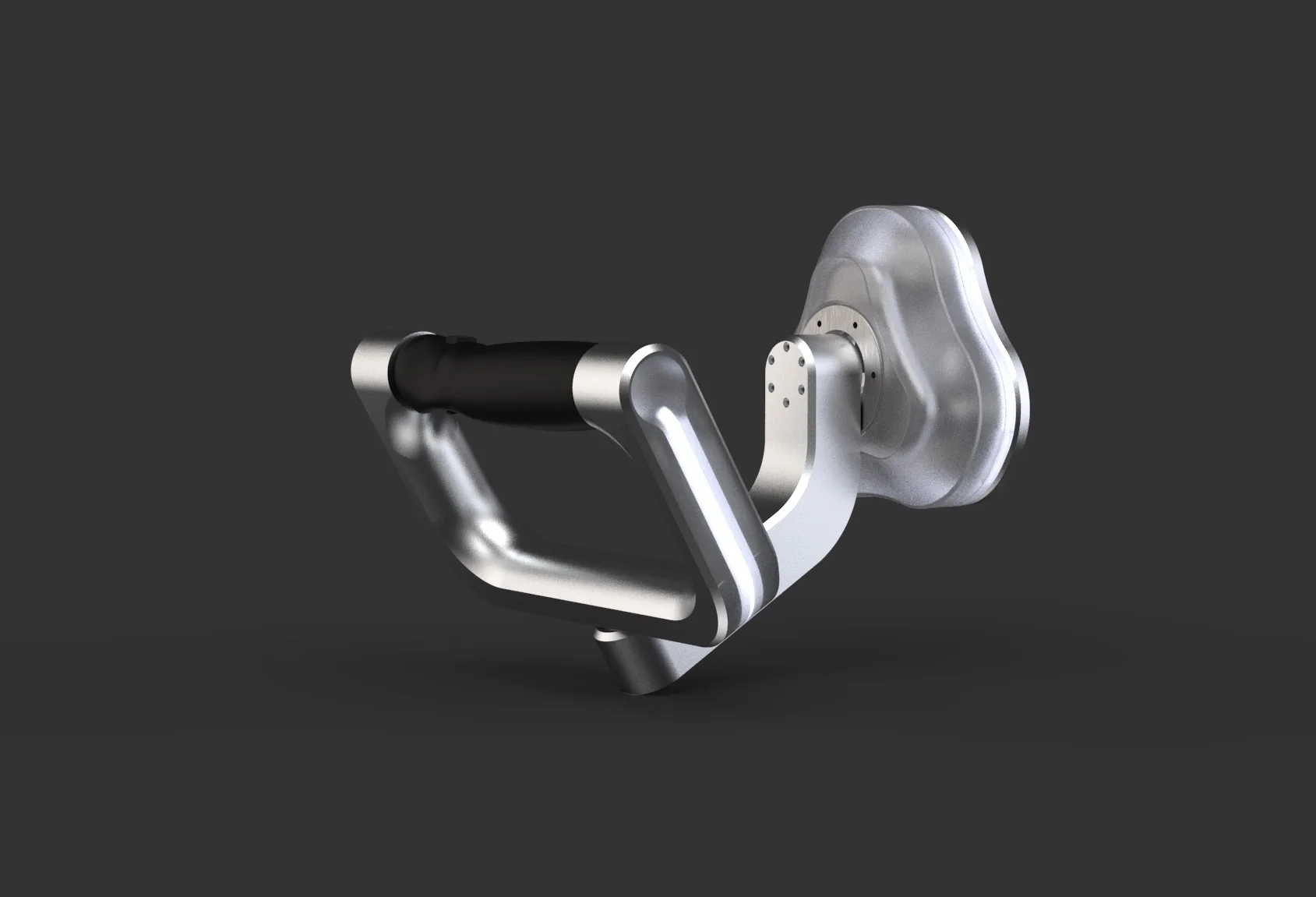
The hand armature of a VR fitness machine: the part you hold while the machine moves with you, or pushes back. We took out its gimbal lock with magnets, made the sensor box smaller and built the electronics into a new grip.
RenderThe final hand armature.
Ethereal Matter asked us to redesign the hand armature.
The Ethereal Engine is a VR fitness machine. Two hand armatures and two foot plates move with you, or drive you, while a headset puts you in another world.
Ethereal Matter, the company of its inventor Scott Summit, asked our team to redesign the hand armature: everything from the grip to the sensor box. It had three problems. The gimbal could lock, the sensor box was bulky, and the grip was close to a copy of a bike grip.
- 01No motors
The gimbal lock had to go without a motor or a fourth axis, by the client’s rules.
- 02A smaller sensor box
Same precision, same output and the same price range, in less volume.
- 03One grip, every input
Joystick, trigger, haptics and a dead man’s switch, inside a grip that stays comfortable.
- 04Wiring that turns
Power and data have to pass three rotating axes.
- 05Strong enough
The sensor box takes 1,300 N from any direction, with a safety factor of 3.
- 06Ready to build
Production runs of 10 machines, scalable to 100.
Repelling magnets keep the grip from locking.
Three axes give the hand full freedom, until two of them line up and the grip locks. The usual fix is a fourth axis with a motor, and the client ruled out both. So we put repelling magnets in the U- and L-brackets. They push the axes apart, so the lock position is never reached or gets skipped over. As far as we could find, nobody had used magnets against gimbal lock before.
We tested three magnet strengths with 10 users. The 2.6 kg magnets were too weak, the 9.3 kg ones too heavy. Two 4.8 kg magnets in the U-bracket and one 9.3 kg magnet in the L-bracket were strong enough to keep the grip from staying locked, and subtle enough to let it pass over the lock position.
Repelling magnets in the U- and L-brackets push the axes apart
Scanned hands and clay models shaped the grip.
The ergonomic design and its tests were also my part. I shaped the grip in clay and then foam, testing each round in the hand; the two best shapes were 3D scanned, rebuilt in Rhino SubD around the joystick and trigger, and printed in TPU for a softer feel.
Gaming and workout zones on one grip
- 01Two positions
Thumb on the joystick for gaming; a closed grip for workouts that keeps force off the buttons. The physiotherapists we interviewed asked for both.
- 02Found blind
With a headset on you can’t see the grip. Its texture tells you how to hold it, and user tests confirmed it.
- 033 cm longer
It fits more of the target group and takes the joystick and trigger into the grip, instead of beside it.
- 04Dead man’s switch
A pressure sensor stops the machine when you let go. Tests through 1 to 5 mm of TPU showed the reading only dropped at 5 mm.
A slip ring carries every signal through three rotating axes.
Every signal from the grip passes three rotating axes. We designed an axis module that holds a slip ring and a magnetic encoder, so the cables survive endless rotation and each axis reports its position without the wear of a potentiometer.
An Arduino prototype tested the buttons, haptic motors and pressure sensor through the slip ring. Load cells in the sensor box read the force of the user, and FEA checked the U-bracket and the sensor box.
Functional prototype: Arduino, haptics and sensors through a slip ring
Ordered five weeks ahead, the prototype arrived in time.
The mechanical prototype and the samples from China were my main part. The aesthetic prototype was CNC-milled from aluminium 6061-T6, blasted and bright anodised.
I ordered it five weeks ahead from a manufacturer in China the client already worked with, and it arrived in time for the final presentation. The covers are printed in semi-transparent PETG and the grip in TPU; the prototype shows the look and feel, while the internal layout lives in the full design.
The machine got its first grip designed for it.
It was shaped from scanned hands and clay models, with the controls built in, and documented with sections, FEA and a bill of materials for production runs of 10 machines, scalable to 100.
For Ethereal Matter it was a way to test a new direction before investing in it, and it did that job: the armature solved key problems of its predecessors (the sensors, the ergonomics, the integration of parts and a smoothly moving assembly) and showed a safety limit that comes with this type of armature. What I took from it: working with an inventor as the client, and ordering parts abroad early enough to put a real prototype on the table.
ClientEthereal Matter Inc., Scott Summit
CourseAdvanced Embodiment Design, TU Delft, coached by Henk Crone
TeamJens van den Berg, Giovanni Cimino, Jordan Groskamp, Vicente Quintana Arntz, Yuka Reinoso Hayashi, Rebeca Sabater Campomanes
Year2022
The moment before something is madeAfter Michelangelo, The Creation of Adam, Sistine Chapel, 1508 to 1512